Neurology Residency - Chattanooga Campus
The University of Tennessee Health Sciences College of Medicine — Chattanooga Department of Neurology works in conjunction with the Erlanger Health System's Neuroscience Institute to treat adult and pediatric patients with a variety of neurological disorders ranging from common to complex. As the region’s only certified academic Neurosciences Center, we provide a comprehensive, multidisciplinary approach to care, giving our patients access to more specialty and subspecialty services than any area health system. Our neurology specialists use the latest advancements in imaging technology to accurately diagnose and develop individualized treatment plans, providing the best possible outcomes for our patients.
ACGME awards Initial Accreditation for our Neurology Residency Program (April 4, 2023)
Welcome to the University of Tennessee Health Sciences College of Medicine — Chattanooga Neurology Residency Program at Erlanger Health. Our four-year categorical program, led by Program Director, Dr. Cleopatra Thurman and Department Chair, Dr. Yassin-Kassab, provides comprehensive training from PGY-1 through PGY-4. The first year of training is offered in partnership with the Chattanooga Internal Medicine Residency Program.
Applicants must apply through the AAMC Electronic Residency Application Service (ERAS) using a single application to the Neurology Residency Program (ACGME Program #1804700002) and be prepared to begin training at the PGY-1 level on July 1, 2027. Applicants should rank the program using NRMP Program Code 1689180C0.
At full complement in July 2027, the program will include 12 residents, with three residents at each level of training from PGY-1 through PGY-4.
Candidates will be considered who will have successfully graduated from medical school and who have passed USMLE Steps 1, 2 CK, and 2 CS on first attempts. International Graduates must have certification from the Educational Commission for Foreign Medical Graduates (ECFMG). Applicants must also be US Citizens, have a Permanent Resident Visa (i.e., "Green Card"), or be willing to apply for a J-1 Exchange Visitor Visa in conjunction with the Program and the ECFMG. The College of Medicine does not sponsor Residents or Fellows on H-1B visas.
Thank you for your interest in our program if you have any questions, reach out to Ms. Stacey Blanks, Residency Coordinator at stacey.blanks@erlanger.org.
View our Neurology Residency Curriculum and Block Schedule.
View more detailed information for Neurology applicants.
Neurology Residency Mission Statement:
The Neurology Resident Training Program of the UT Health Science Center College of
Medicine-Chattanooga aims to graduate competent physicians capable of providing superb
and up-to-date medical care for large and various communities in terms of neurological
disorders and diseases. These physicians should be very comfortable providing neurological
medical care and consultations both in acute urgent or chronic settings, in inpatient
care facilities such as hospitals, medical centers, emergency rooms, and intensive
care locations, or in outpatient clinic locations.
Clinical care provided is expected to remain always within current guidelines, so part of the mission of this training program is to focus on continuous medical education during and after graduation, and staying current with medical societies, clinical trials, and relevant legislative bodies. Erlanger Health System and its adult hospital (Baroness Erlanger Hospital) -- the primary clinical training site -- has a medical mission that is in alignment with the training program mission above. It has been, since established, a safety net for all community members in the Chattanooga area. Its level one trauma center and comprehensive stroke center status are the only ones found in the region. With a draw are from three different states (Tennessee, Georgia, and North Carolina), it provides both the inpatient and outpatient population needed for the training program, as well as the complexity to understand and learn about complex acute management and continuity of care.
Neurology Residency Program Aims:
- Provide a perfect environment for learning by exposing Residents to a wide variety of neurological cases in the community. Erlanger Health System is the main and largest tertiary medical care center in the region. It has the only comprehensive stroke center in the Chattanooga and surrounding community and has received the highest annual recognition from the American Heart Association in the fields of stroke care over the last six years.
- Provide a rich schedule of didactics, both in person and virtual learning to expand and refine knowledge, ethics, professionalism, and patient care.
- Provide education in specialized care in neurology through several available neurological subspecialty clinical practices with the same main training site including headache, stroke, epilepsy, neuromuscular, movement disorders, sleep medicine, dementia, and multiple sclerosis. These are available both on the inpatient and outpatient fronts.
- Focused, scholarly teaching to enrich the culture of staying current with medical advances, guidelines, and literature through critical analysis of journal articles and society memberships.
- Provide opportunities for research, quality and patient safety project participation, leadership, and teaching through the duration of the program while providing relevant mentors for residents based on their individual interests, supervised teaching, and scholarly work, including administration (such as in the role of a Chief Resident).
Neurological Care and Treatment provided at Erlanger:
Led by the Department of Neurology Professor and Chair, Mounzer Yassin-Kassab, MD,
MS, our Neurology faculty provide the following neurological care and treatment at
Erlanger:
- Neurovascular Disease (Stroke)
- Neuromuscular Medicine
- Movement Disorders
- Memory and Aging
- Neurosurgery and Spine
- Sleep Disorders
Our faculty and board certified by the American Board of Psychiatry and Neurology and are fellowship trained in their neurological subspecialties. The Neuroscience Institute is the region's only certified comprehensive stroke center -- the sixth busiest in the nation -- and attracts specialists from across the world to learn next generation techniques. It also sponsors the region's most comprehensive program for treating back pain with the most cutting edge neurosurgical techniques and the region’s only epilepsy monitoring unit.
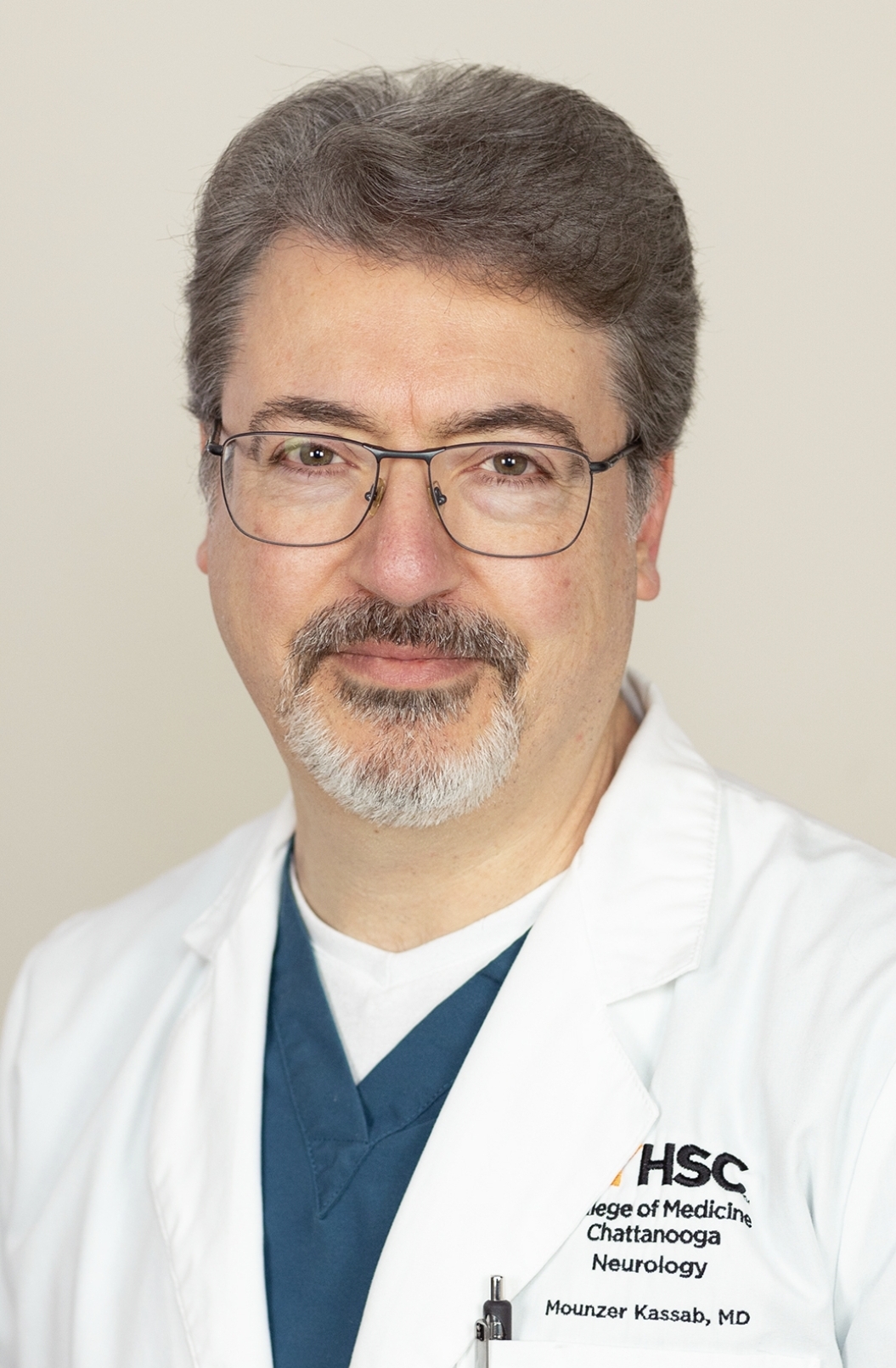
Dr. Yassin-Kassab is board-certified in neurology, clinical neurophysiology, vascular neurology (stroke) and epilepsy. He serves as Medical Director for Erlanger Neurology, Professor and Chair of the Department of Neurology at the college, and is the founding Program Director for our Advances Neurology Residency
Dr. Yassin-Kassab is a member of the American Academy of Neurology and the American Epilepsy Society and graduated from Tishreen University Medical School. He earned his Master of Science degree in Neuroscience from the State University of New York Health Science Center in Syracuse. Dr. Kassab also completed his Neurology Residency, Clinical Neurophysiology Fellowship and Vascular Neurology (Stroke) Fellowship at the University of Texas Dallas and Southwestern Medical Center and has participated in numerous national and international clinical trials, is well-published, and has given national and international presentations on stroke and epilepsy topics.
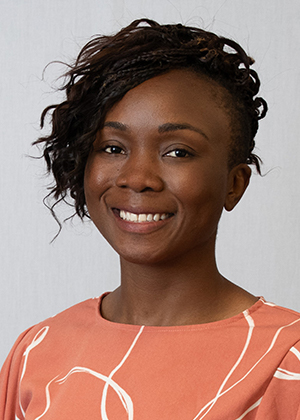
Dr. Cleopatra Thurman is board-certified in neurology and vascular neurology, specializing in stroke and cerebrovascular disease. She serves as Program Director of the Neurology Residency Program, Inpatient Neurology and Stroke Program Medical Director for Erlanger Health System, and Assistant Professor of Neurology at the University of Tennessee Health Science Center College of Medicine–Chattanooga. Her professional interests include graduate medical education, stroke systems of care, clinical research, quality improvement, and community stroke education.
Dr. Thurman earned her Doctor of Osteopathic Medicine degree from Michigan State University College of Osteopathic Medicine. She completed her neurology residency at Sparrow Hospital and Michigan State University, where she served as Resident Education Chief and received the Resident Clinical Excellence Award. She subsequently completed a vascular neurology fellowship at the Hauenstein Neuroscience Center at Mercy Health Saint Mary’s in Grand Rapids, Michigan.
Dr. Thurman is a member of the American Academy of Neurology, American Neurological Association, American Heart Association/American Stroke Association, and World Stroke Organization. She has served as a site principal investigator for international, multicenter Phase III clinical trials in stroke prevention. She has also participated in international research and educational initiatives focused on strengthening neurologic care and research capacity in Zambia. Dr. Thurman is committed to training future neurologists, advancing evidence-based stroke care, and expanding stroke education for emergency medical services and underserved communities.